Cue the collective SEO gasp.
Search just hit a milestone worth paying attention to.
SparkToro, based on Similarweb's US desktop and mobile clickstream panel covering January to April 2026, found that
68.01% of Google searches ended without a click.
Anywhere.
Not to your site. Not to a competitor's site. Nowhere. Not the open web, not a paid ad, not even Google's own pages.
Worth flagging: this is a US-only, search-level figure. It measures average behaviour across all Google searches, not a specific niche, industry, or set of websites, so individual results will vary by query type and vertical. SparkToro also notes that its historical comparisons draw on different data panels year to year (Jumpshot in 2016/2019, Datos in 2024, Similarweb in 2026), so the long-term trend should be read directionally rather than as a precise apples-to-apples comparison.
Even with that caveat, the direction is consistent, and the two-year jump, from 60.45% in 2024 to 68.01% in 2026, is the fastest acceleration SparkToro has recorded.
Two decades of measuring SEO success in rankings and clicks, and the scoreboard is shifting.
The question isn't only about “how do we get more clicks?” anymore.
It's “what's still earning visibility, and how do we measure it?”
This isn't new. The speed of it is what's worth paying attention to.
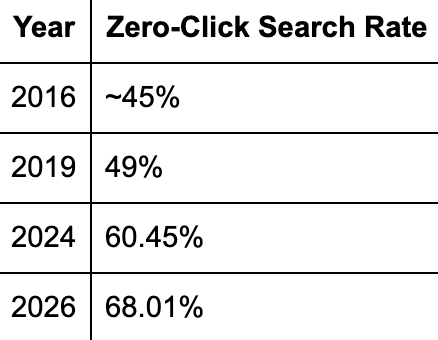
That's 7.5 percentage points of growth in two years. The fastest acceleration in a decade.
And no, it's not one single feature to blame:
The reassurance: if you're doing the right SEO work, that effort isn't wasted. The goalposts moved. Where you point that effort just needs to move with them.
Tempting. Wrong.
AI Mode made up just 0.34% of searches between January and April 2026, despite blowing past one billion monthly users and doubling its query volume every quarter.
What actually got Google to 68%? A decade of small, boring UI tweaks designed to keep you inside Google's ecosystem. Not one dramatic AI launch.
We broke down exactly how that happened in Google's AI-Driven Search Overhaul.
One-third of searches are still up for grabs. Who's actually getting them?
Cyrus Shepard at Zyppy dug through 400+ winning and losing sites to find out.
Winning sites share these traits:
84% of winning sites let visitors complete their task on the page. Sites losing ground? About half. Losing sites tend to be informational in nature: content that explains something well, then routes the user elsewhere to act on it.
These traits stack. One strength won't cut it alone. The advantage comes from being a genuine destination, not just a stop along the way.
Good news buried in this data: if your page already explains a procedure or product clearly, you're most of the way there.
Add a direct path to act, book it, quote it, calculate it, contact the team, and you're in the winning column. This isn't a rebuild. It's a relatively low-lift add-on.
Booking widgets. Calculators. Quote tools. Clear next-step CTAs. These aren't conversion nice-to-haves anymore. They're ranking signals.
Sit with this one. It's a genuine head-scratcher.
Clicks are falling. But the clicks arriving via AI are worth more.

People use AI for the boring early stage: comparing, narrowing, and skimming reviews. By the time a human actually clicks through, they're already halfway down the funnel, and more ready to act.
Sound familiar? Brands including HubSpot are reporting the same “traffic down, revenue up” pattern we called out in AI Search Breaks Last-Touch Attribution.
Ranking first still matters.
Organic authority feeds AI Overview inclusion, and pages that rank well get cited in AI answers at way higher rates than pages that don't. Your ranking work isn't wasted.
Here's what's actually changing: a strong ranking and a traffic spike used to be the same win. Not anymore. A site can be performing well in search even when the visit numbers sit flat. That's not a red flag. It's the new normal.
The move now is to widen the lens: track branded search growth, citation presence in AI answers, and the quality of the visits that do convert, right alongside your traffic numbers.
The brands building that fuller picture now are the ones who'll be able to point to real commercial impact from their SEO, even as the click landscape keeps shifting. That's what good SEO looks like in 2026.
Keep yourself informed and up to date with our engaging and educational blog posts. Explore a wide range of topics and stay connected with our latest content.